

In semiconductor technology, materials and thus analytical issues are changing rapidly. Thanks to its superior depth analysis capability, the CAMECA IMS 7f-Auto is widely used to monitor dopants in the semiconductor industry and is applicable to various types of materials and material systems. Among the advantages of the device: two high-brightness ion sources (Cs+ and O2+), high transmission, high mass resolution…
Excellent detection limits for deep implants
For deep implants, depth profiles of up to several micrometers can be analyzed within minutes, with impressive sensitivity and a high dynamic range. For the three main dopants of Si (B, P, and As), detection limits in the ppb range can be achieved. In contrast to TOF-SIMS, detection limits are improved in the IMS 7f-Auto with increased bombardment rates.
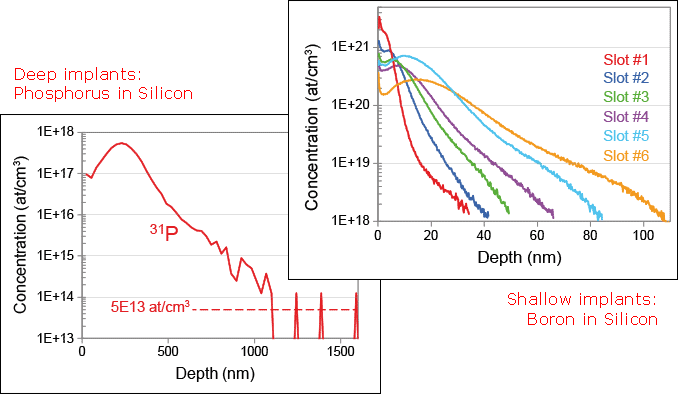
Left: Phosphorus in Silicon - excellent detection limits and high sample throughput (total analysis time of 200 seconds) for deep implants.
Depth resolution optimized for shallow implants.
On the CAMECA IMS 7f-Auto, the collision energy can be continuously reduced to 500eV, providing excellent depth resolution while still maintaining good sensitivity. Therefore, the IMS 7f-Auto can be used to characterize the depth distribution of dopants and impurities on shallow implanted or thin film structured samples.
Right: Shallow boron implants in Silicon - excellent depth resolution for depth analysis at low energy.