
Main features
- Large mass dispersion ~1700 mm, base resolution >800 (10% valley), significantly higher than all standard MC-ICP-MS
- Maintains a flat peak at a resolution >5000 – retains the flat-top shape even when achieving a resolution >5,000, minimizing sensitivity loss, ensuring accuracy in simultaneous isotope measurements
- High-resolution independent slits for each detector – each detector has its own variable slit, allowing different resolution settings for each detector, optimizing multiple isotope systems simultaneously
- Two flexible resolution modes – integrating both True High Resolution (individual detector slits) and Pseudo High Resolution, meeting diverse requirements for interference separation capabilities
- Highly customizable detector configuration – 16 Faraday cups (10 fixed + 6 movable) with software-switchable preamps; up to 5 ion counting detectors (SEM/Daly) with deceleration filters to enhance mass sensitivity
- Variable Zoom Optics – instantaneous switching between isotope systems during analysis without physical intervention
Detailed description
Technology & principles
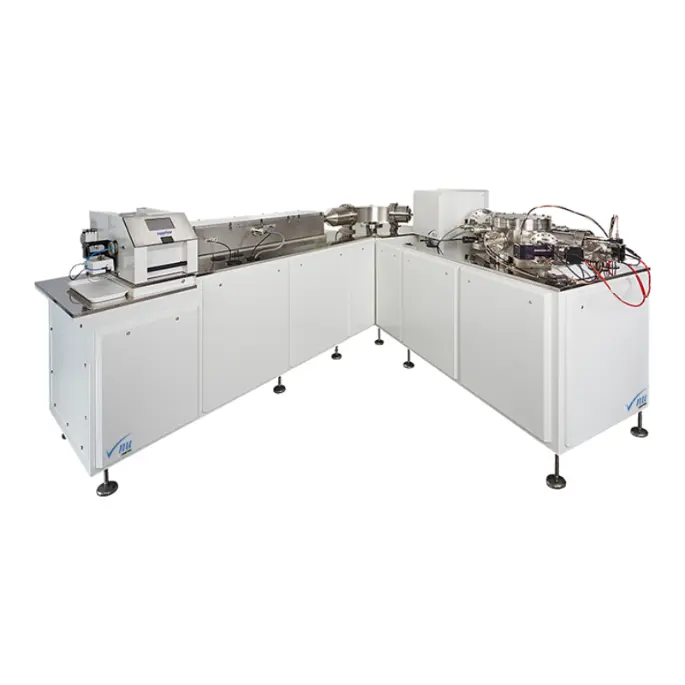
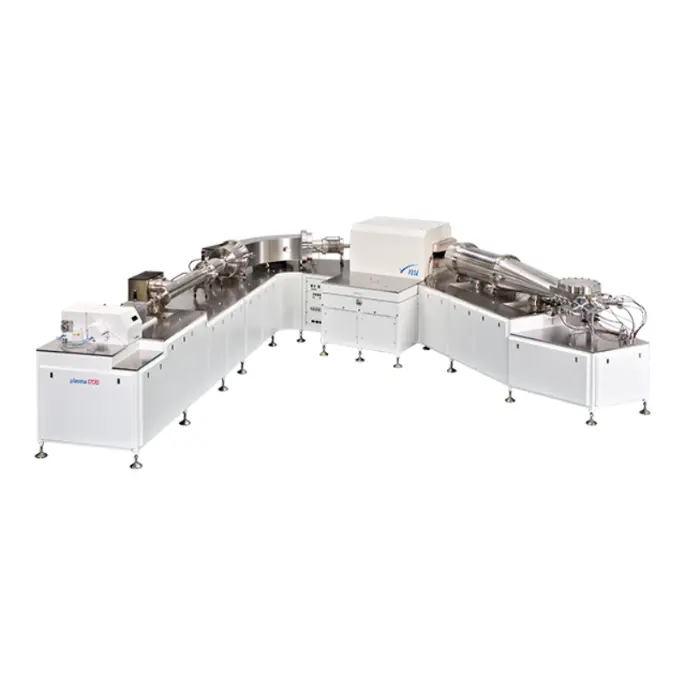
Nu Plasma 1700 is a double-focusing MC-ICP-MS with a static electric field (ESA) radius of 943 mm (70°) and a magnet of 750 mm (70°), with a total magnet weight of ~4.5 tons. The mass dispersion is ~1700 mm (double that of the standard machine) → base resolution >800 (10% valley), sufficient to analyze nearly 40% of isotopes at maximum sensitivity. ICP source 27 MHz, 2000 W. The narrow source slit is continuously adjustable to select the appropriate resolution.
Các hạn chế thông thường của ICP-MS:
Light isotopes (Fe, Ca, Cr, Si, Mg) are interfered with by Ar⁺, ArO⁺, ArN⁺, ArH⁺. The traditional solution (narrowing the source slit) loses 98–99% of ion intensity, resulting in poor accuracy.
Advantages of the Nu Plasma 1700 system
- Large geometry → base resolution >800, analysis of 40% of isotopes without loss of sensitivity.
- Exclusive True High Resolution: >5,000, flat-top peak, no significant loss of sensitivity.
- Independent narrow slits for each detector → simultaneously optimizes multiple isotopic systems.
- Complete interference separation even when interference is on both sides of the peak.
Integration & expansion
- Compatible with laser ablation (LA-MC-ICP-MS) for in-situ analysis, isotopic mapping.
- Differential pump, dry pump configuration → reduces hydrocarbon background, stable.
- Mass range 3–300 m/z (Li to U).
- Deceleration filter for ion counting detector, improving abundance sensitivity (<300 ppb).
- Software-switched preamp → expands dynamic range.