

Main features
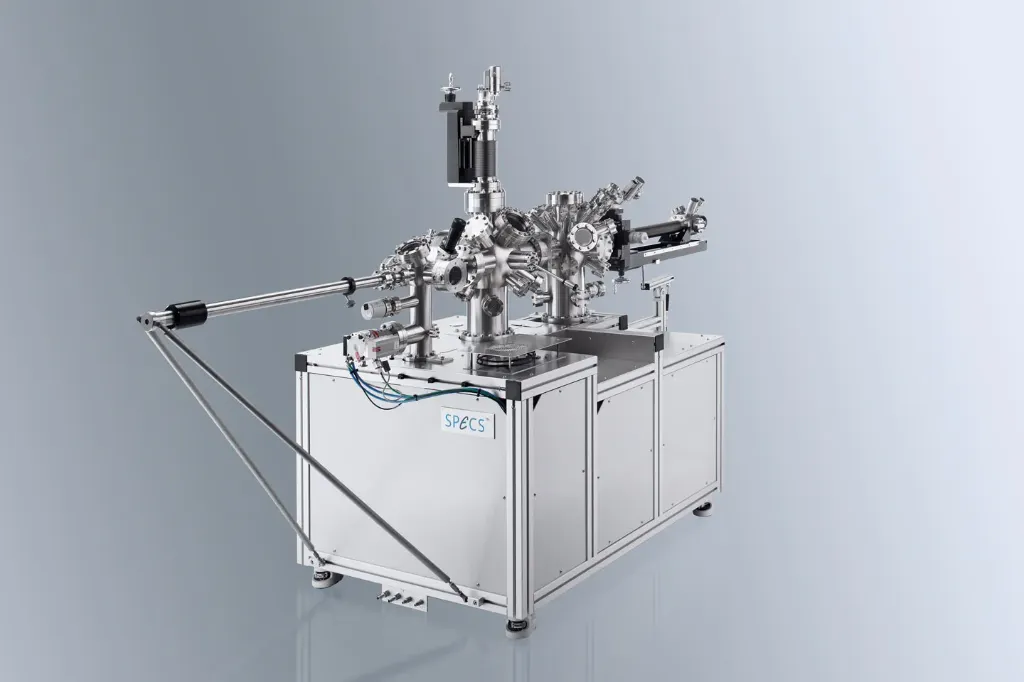
- The Aarhus SPM probe head includes a reaction chamber and a radiation heating unit to operate at pressures up to 100 mbar.
- The inside of the reaction chamber is made from inert materials or coated with non-reactive materials.
- Two observation windows in the reaction chamber are used to project UV-VIS radiation onto the sample during the in-situ scanning process.
- Nanonis SPM control system
- Temperature range: 130 K - 500 °C in ultra-high vacuum (UHV) conditions, room temperature (RT) - 250 ° at a pressure of 10 mbar N₂.
Detailed description
Technology & Principles
NAP-SPM is a scanning probe microscopy system designed for atomic resolution material surface research. The device operates based on the principle of using a micro probe to scan the sample surface to record force interactions or tunneling currents under pressure conditions approaching the natural environment, with two core modes including Scanning Tunneling Microscopy (STM) and Atomic Force Microscopy (AFM). The system integrates a vacuum chamber design and a high-stability sensor mechanism from the SPM 150 Aarhus line, allowing for the observation of atomic structures, surface development...
High-resolution and stable scanning probe microscope system
Elimination of mechanical noise and temperature drift commonly encountered in high-pressure measurement chambers thanks to the anti-vibration structure and high-resolution measurement mechanism inherited from the SPM 150 Aarhus platform, maintaining stable resolution at the atomic scale.
Wide operating temperature range
Addressing challenges in studying material growth processes or thermal catalytic reactions due to the ability to operate flexibly at various temperature levels, supporting the monitoring of surface dynamic evolution (in-situ dynamic processes) in real time.
Simultaneous integration with the NAP-XPS system
Eliminating the need to transfer samples back and forth between different devices that contaminate the surface by directly combining with the near atmospheric pressure X-ray photoelectron spectroscopy analysis system (NAP-XPS), providing comprehensive data on both micro-morphology and elemental chemical state.
Integration/ Expansion:
The device is fully compatible with vacuum sample preparation systems, precisely controlled reaction gas loading systems, along with various sample heating/cooling accessories. The entire subsystem is managed by specialized control and image processing software, providing an optimal expanded platform for in-depth studies of heterogeneous catalysis, surface science, nanotechnology, and advanced materials.