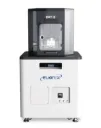

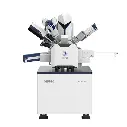
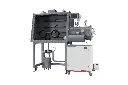
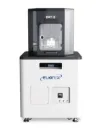
Main features
Viscoelasticity test:
- Integrates the ability to create oscillating loads at optional frequencies, combining continuous indentation into the sample under a constant background force.
Supports accurate measurement of the kinetic properties of materials including:
- Storage modulus
- Loss modulus
- Loss factor
- Ability to combine with heating stage
In-liquid test:
- Supports the execution of nanoindentation measurements (hardness and elasticity) directly while the sample is submerged in water or other specialized liquids.
Micro-particle compressive strength test:
- Note: Only applicable for the integrated High load unit configuration.
- Uses a flat-ended indenter to apply compressive force or crush fine particles.
- Accurately determines and measures the compressive strength as well as the deformation behavior of the particles under load.
Detailed description
Ability to apply on a variety of material types
- Types of thin film materials such as coatings and hard films.
- Resin plastic materials, film materials.
- Ultra-thin film like carbon similar to diamond (DLC - Diamond-Like Carbon).
- Functional resin film and surface modification film.
- Microparticles and powder materials.
Nanoindentation test
- Accurately determine mechanical properties such as hardness and elastic modulus of thin films, extreme surfaces, and micro-sized regions.
- No indentation observation is required due to the ability to directly analyze the load-displacement curve to obtain material properties..
- Strictly comply with international standards ISO 14577-1 / JIS Z 2255.
Data reproducibility and maintainability
Temperature control mechanism
- Eliminate the thermal expansion phenomenon of the sample and testing equipment.
- Control the internal temperature of the wind tunnel chamber at a stable ±0.1°C.
- Use materials with a low thermal expansion coefficient (Nobinite) for measuring components.
- Completely prevent the influence of external air currents.
High precision positioning stage
- Applying high-precision template technology developed in-house from the company's electron beam lithography (EBL) equipment.
- Movement positioning capability with 0.1 µm fine-tuning steps.
- Measure at any desired location with an observation magnification of up to 2,000x (when using a standard 20x objective lens combined with digital zoom).
Anti-vibration mechanism
- High-precision wedge-shaped stage design with superior vibration resistance.
- Equipped with a standard active anti-vibration table.
Software (Control Software)
- Integrate auxiliary functions such as: indenter tip correction, temperature drift correction, and reminders for daily periodic inspection.
- The interface and operating procedures have been optimized through many years of practical experience.
Data reproducibility
- Enhance the repeatability of data through mechanisms that eliminate environmental noise effects (such as vibrations and temperature variations).
- Ensure stable data collection capability even in continuous measurement mode.
Maintainability
- Easily replaceable flexibly between the high load unit and the low load unit.
- Minimize equipment downtime through the calibration process carried out by swapping these modules.
Load Unit
High load unit:
- Support for the test force range from 5 µN to 2 N.
- Compatible with hardness measurement tests for a wide range of materials, from metals to polymers.
- (For example, typical measurement: Measurement on Fused quartz with a test load of 100 µN, performed 9 repeated presses).
Low load unit:
- Supports a very small force range from 0.5 µN to 10 mN.
- Provides superior repeatability and stability for measurements on soft materials (elastic modulus $\le$ a few GPa) and measurements with a depth of indentation below 10 nm.
- Optimally suitable for evaluating the mechanical properties of functional plastics (such as UV-cured plastics), low-k films, elastic materials (such as silicone rubber), and ultra-thin hard films (such as DLC films).