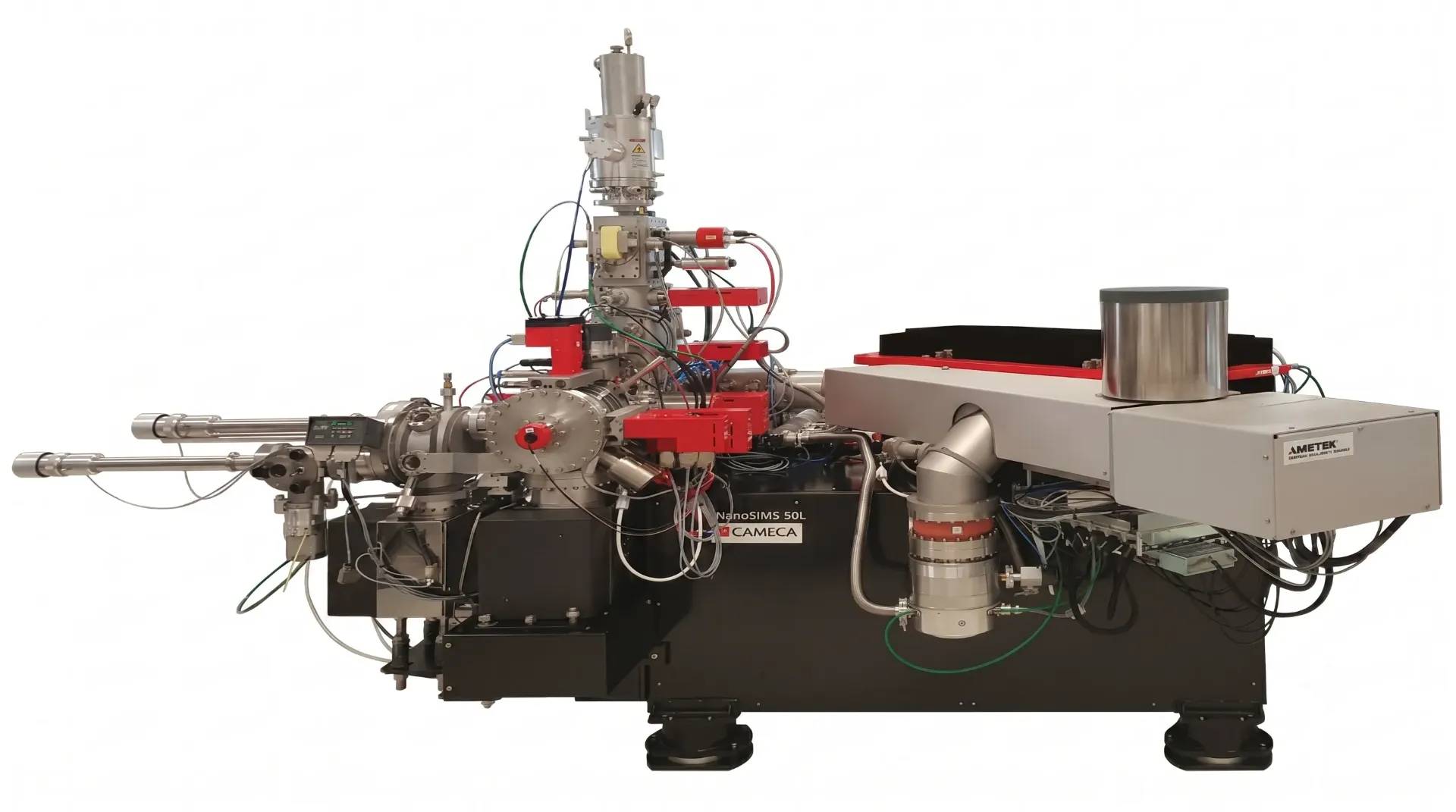

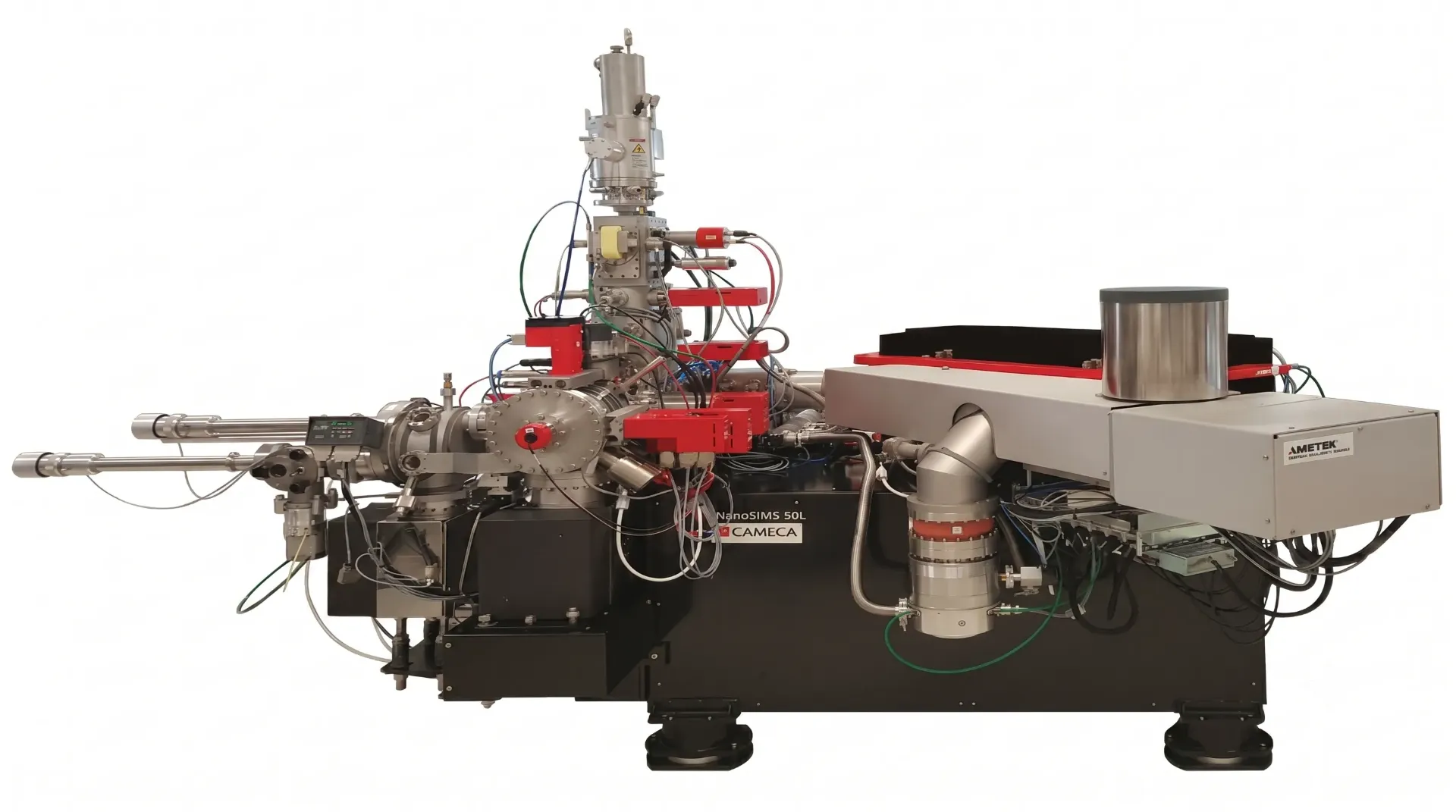
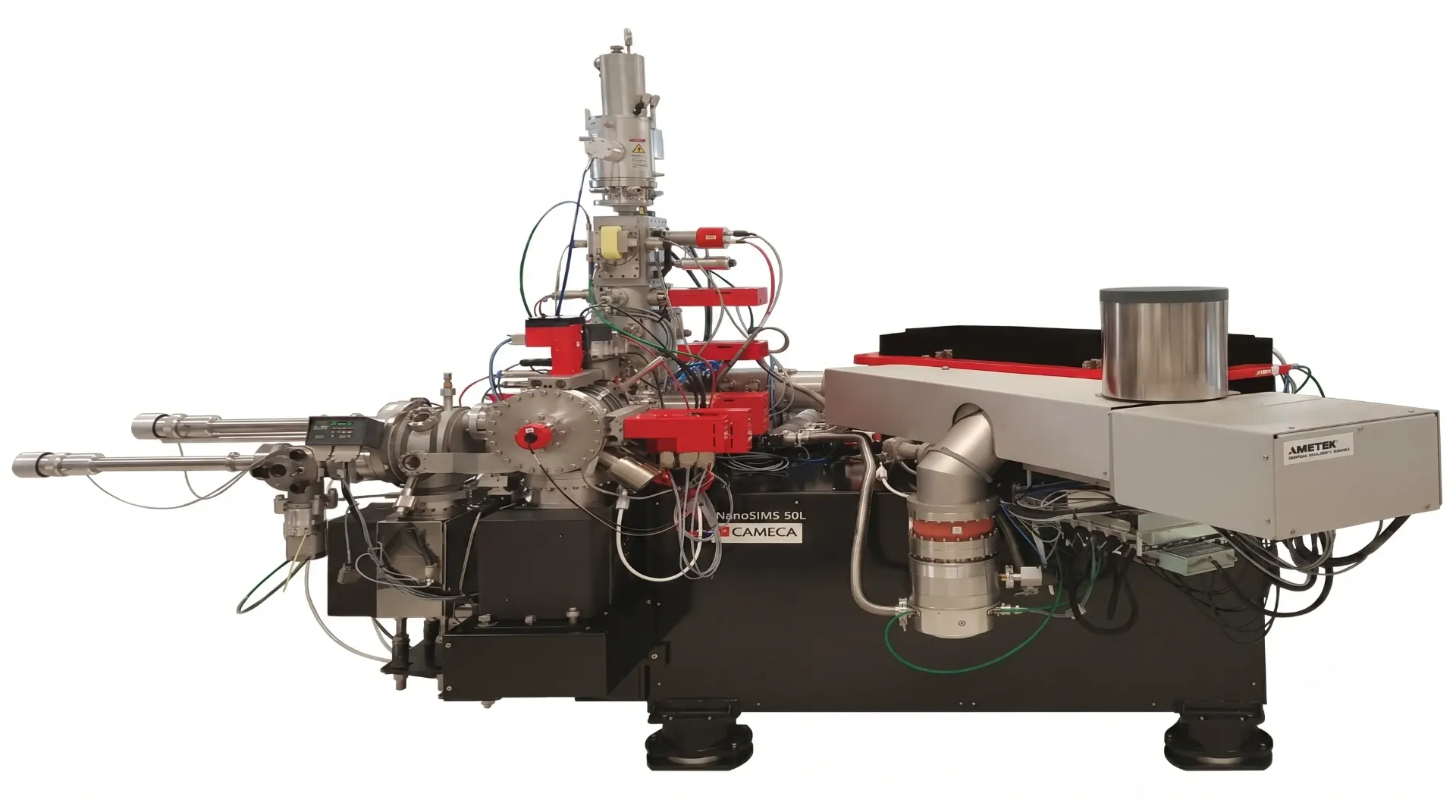
Key features
- Co-axial optical design: Eliminates shadowing effects and signal distortion, maintaining a perpendicular incidence angle to optimize the collection of secondary ion beams and extremely high transmission.
- Dual multifunction primary ion source: Integrates high-brightness Oxygen (RF-plasma) and Cesium (Cs+) sources, significantly enhancing ionization yield for elements with a wide range of electronegativity from hydrogen to plutonium.
- Multi-channel parallel signal acquisition: The magnetic mass analysis system is equipped with 7 independent detectors (EM/FC) allowing simultaneous recording of 7 different mass ranges, eliminating cross-talk and optimizing time.
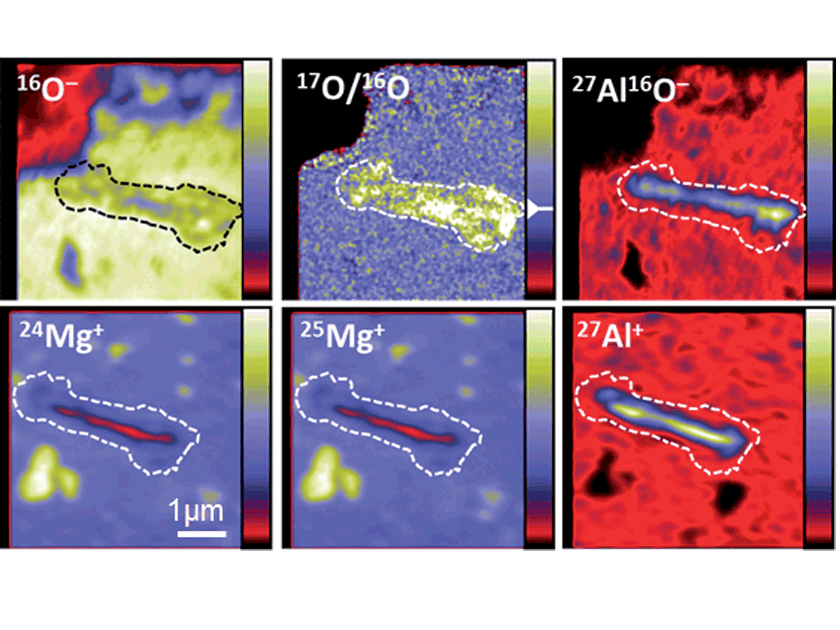
- Superb spatial resolution: The ability to maintain a stable beam (DC mode) creates an extremely small focal point <50 nm, enabling precise localization and quantification of trace impurities (dopants) at the nanoscale level.
- Non-destructive sample survey: Integration of short-focus optical microscopy and the Point Logger digital navigation feature, assisting in accurately identifying the area of interest of the sample before starting ion beam shooting.
- Comprehensive automation capability: The entire process of aligning the aperture, slits, or transferring samples is monitored through a high vacuum load-lock chamber, directly managed by computer software.
Detailed description
SIMS analysis technology with co-axial optical system
In traditional ion mass analysis systems, projecting the beam at an angle often causes shadowing effects and distorts signal collection capability. The CAMECA NanoSIMS 50L completely addresses this issue with its unique co-axial optical design. The primary ion beam is projected perpendicularly directly onto the material surface, while simultaneously collecting the secondary ions emitted along the same axis. Combined with the absence of obstructive lenses, the device maintains maximum signal transmission even when operating at extremely high mass resolution.
Solving the problem of measuring isotopes in the sub-micron range
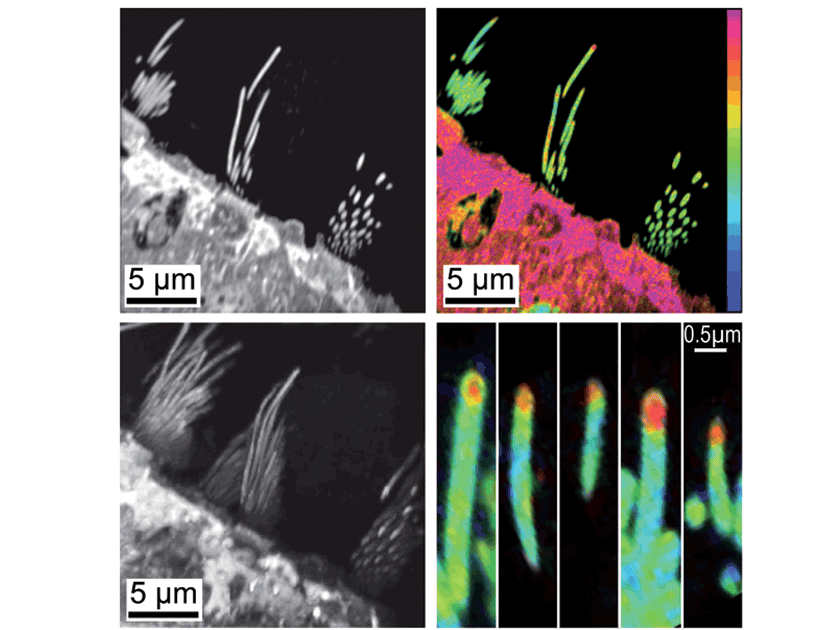
Collecting quantitative data on extremely small crystalline particles, cosmic dust, or biological cell structures often faces significant obstacles due to low signal boundaries. The NanoSIMS 50L addresses this issue by using a multicollection system with 7 parallel mass detectors, including Faraday Cup assemblies and Electron Multipliers. By operating in continuous analysis beam mode (DC mode) instead of pulsed mode like TOF-SIMS systems, the device minimizes signal noise and achieves isotope ratio reproducibility at a level of a few tenths of permil, a high standard for the fields of biomedicine and geochemistry.
Automation and flexible scaling for multiple applications
Protecting samples from environmental exposure is a stringent factor in microanalysis. The NanoSIMS 50L is equipped with an ultra-high vacuum (UHV) chamber combined with the load-lock station that can be pumped down using a separate turbomolecular pump. In terms of scalability, the system allows for the integration of an additional secondary electron detector (SED) to enhance the contrast of topographical images, or the addition of a supporting NMR probe to stabilize the magnetic field when measuring Hydrogen ratios. The device is fully operated through the WinImage II software platform on Windows, which has the capability to mirror the control screen remotely to minimize disturbances caused by humans in the lab.