
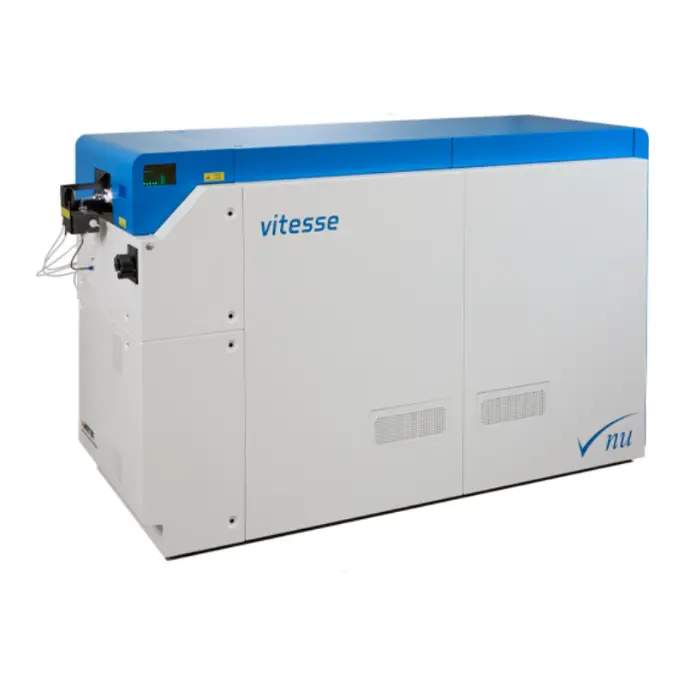
Key features
- Record-breaking acquisition speed – continuous mass spectrum acquisition at 33 kHz – 200 kHz, allowing for the capture of the entire mass range at the fastest speed without interruption.
- Megapixel resolution imaging – combined with a high-speed laser system, Vitesse allows for the creation of elemental distribution maps over cm² with micron resolution in just a few minutes.
- High sensitivity on complex sample backgrounds – superior sensitivity allows for probing micron-sized elemental traces in solid samples and determining the elemental composition of individual nanoparticles.
- Segmented reaction cell – cell specially optimized for multi-element analysis, with multiple gas reaction ports, effectively eliminating spectral interferences such as Ar, Kr, Rb.
- Flexible Quad-Cell-TOF (QCT) option – an optional full-size quadrupole added before the reaction cell enhances the ability to handle difficult interferences, providing optimal flexibility.
- 10-order dynamic range and diverse analytical capabilities – combines a proprietary ion beam attenuation system (Physical Beam Attenuator), allowing for the analysis of both ultra-low and high concentration samples on the same sample background.
- Integrated powerful Nu Quant software – data processing for single-particle, imaging, flow cytometry modes, minimizing processing time.
Detailed description
Technology & principles
Vitesse is an ICP-MS that uses a Time-of-Flight analyzer instead of the traditional quadrupole. Ions are accelerated, flying in the flight chamber, with the time of flight proportional to the square root of m/z → recording the entire spectrum simultaneously after each pulse. The collection speed is hundreds of times faster than sequential mass-filtering ICP-MS, particularly suitable for transient signals from laser ablation, single-particle.
Common limitations of ICP-MS:
Traditional ICP-MS (QMS, HR) measures sequentially, unable to record the entire spectrum for short signals (nano-particles, laser pulses). When imaging, thousands of pixels are needed, each point only a few tens of ms → not fast enough. spICP-MS (single-particle) measures only one element at a time, ignoring multi-element correlation.
Ưu điểm của hệ thống Vitesse
- TOF records the entire spectrum from 7–240 amu simultaneously, with a reading rate of up to 200 kHz, superior time resolution.
- A rate of 33 kHz creates a megapixel elemental map, providing detailed elemental distribution.
- spICP-MS simultaneously records all elements in a nanoparticle, determining multi-element composition and correlation.
- Imaging achieves millions of pixels, increasing spatial resolution without extending time.
Integration & Expansion
Compatible with laser ablation (LA-ICP-TOF-MS) from Elemental Scientific Lasers, Applied Spectra.
Combines flow cytometry for single-cell, simultaneously measuring metal markers and endogenous elements (Fe, Ca, P).
Automatic sample loading option for high throughput solutions.
Supports hydride/cold vapor source, GC.
Nu Quant software for specialized data processing.