
Key features
- Optical integration (BIO only) – Directly attaches to Olympus, Nikon, Zeiss inverted microscopes; supports brightfield, phase contrast, epifluorescence, TIRF, FRET, confocal. Has separate top-view optics for laser alignment and probe positioning on the sample.
- Superior mechanical performance (Infinity) – Unique tripod base creates a short and rigid mechanical path, background noise <20 pm (33% lower than other large sample AFMs). New generation LVDT sensor, highly stable, no periodic calibration required.
- Precise picoNewton force measurement (entire range) – Beam bending noise <15 pm (typically 8 pm), standard Z range >15 μm (optional >40 μm), closed-loop control for precise force. Supports Force Mapping, Force Clamping, protein strength analysis, soft tissue elasticity.
- Dozens of AFM modes available (entire range) – Contact, Tapping, Phase, MFM, EFM, KPFM, PFM, Dual AC, DART, Loss Tangent, Force Modulation, Nanolithography, Switching Spectroscopy PFM, etc. Origin+ and Infinity additionally support AM-FM, Contact Resonance, CAFM, sMIM, ESM, SThM.
- Powerful, user-friendly software – ModeMaster automatically configures modes, GetReal calibrates cantilever without touching the sample, GetStarted optimizes Tapping parameters, MacroBuilder drag-and-drop creates macros, supports IGOR Pro scripting.
- Good support and warranty – Comprehensive 2-year warranty (Infinity, BIO) or 1-year (Origin), lifetime free technical and application support.
Detailed description
Technology & principles
AFM operates based on scanning a very sharp probe (tip) on the surface of the sample. The probe is attached to the end of a cantilever with a defined elasticity. The interaction force between the probe and the sample surface bends the cantilever, which is detected by a laser beam reflected onto a photodiode. The MFP-3D series uses an 860 nm wavelength infrared SLD laser configuration, reducing interference noise, compatible with far-red fluorophores.
Common limitations of AFM
AFM needs to be combined with optical microscopy – many bioAFM systems have "holes" that reduce stiffness, incompatible with high NA objectives. Low-cost AFM uses fragile piezo tubes, lacks position sensors, and is difficult to zoom/offset. Advanced modes (PFM, CAFM, AM‑FM) often require separate module purchases.
Advantages of the system MFP‑3D
- MFP‑3D BIO: solid flexure head (no holes), high stiffness; customizable optical condenser projecting phase contrast from above; compatible with TIRF, high NA.
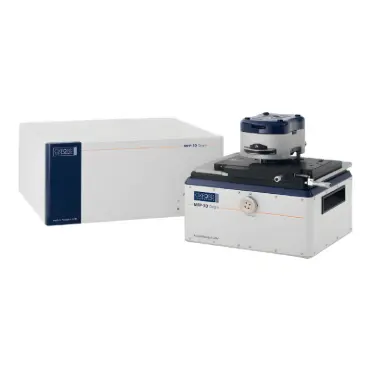
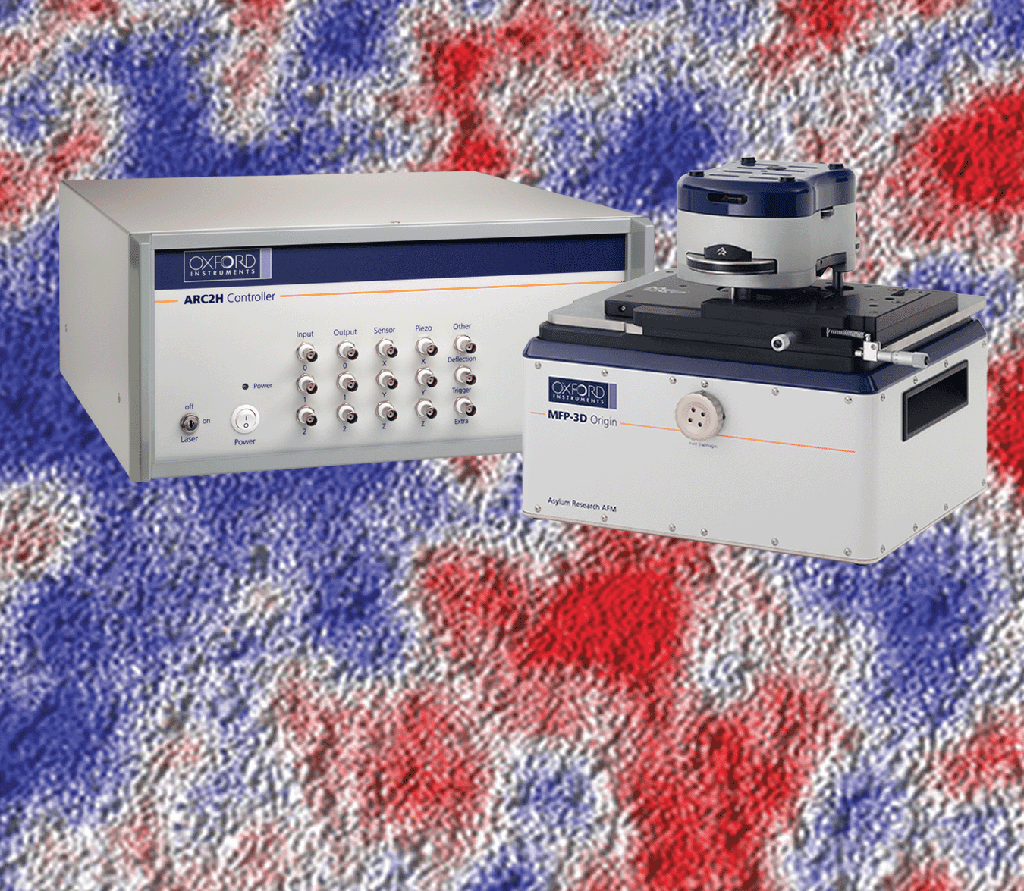
- MFP‑3D Origin/Infinity: flexure replaces piezo tube, LVDT sensor, durable scanner, no need for recalibration. Infinity has an active soundproof casing, side-swing door.
- Origin+/Infinity includes many standard advanced modes at no additional cost; upgrade from Origin.
Integration & expansion
- Temperature accessories: BioHeater (80°C), Petri Dish Heater (45°C), PolyHeater (400°C), CoolerHeater (-30°C to 120°C).
- Environmental accessories: Closed Fluid Cell, Fluid Cell Lite, Humidity Cell, Electrochemistry Cell, MicroFlow Cell.
- External force accessories: Variable Field Module (magnetic field 0.8 T), NanoRack (stress 80 N), High Voltage Field (±150/±220V), Probe Station, Photovoltaic.
- 2D/3D overlay software for AFM and optical images, real-time rendering, Imaris image export.
- Supports remote control, online training.