

The long-term behavior of glass types used to contain nuclear waste is a top concern to ensure safe geological disposal. To understand the mechanisms of glass alteration, it is important to study the formation of alteration layers (e.g., gel and phyllosilicate for silicate glass) that develop when exposed to aqueous solutions. This requires in-depth elemental characterization as well as the use of isotopic tracers, a powerful method to study the exchange between the solution and the glass.
Providing excellent depth analysis capabilities for low concentration elements and high-precision isotopic ratio analysis, the IMS 7f-Auto is the most suitable tool for analyzing nuclear glass and studying the mechanisms of glass alteration.
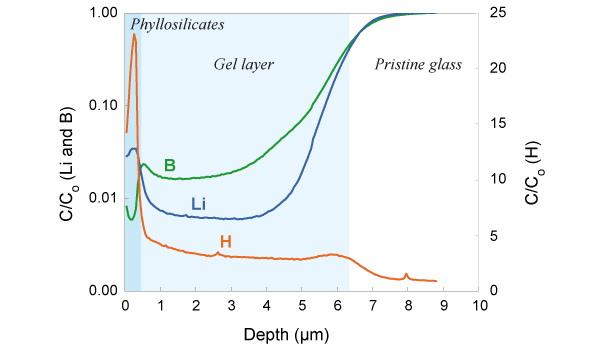
The figure above shows the depth distribution charts of B, Li, and H for a type of altered glass after 3 months. The original glass shows high concentrations of B and Li and low H content. The gel layer is depleted in B and Li. Near the free surface, H and Li enrichment is observed along with a decrease in B. Concentrations are normalized to the original glass composition (C/C0).
The IMS 7f-Auto is also used to perform meaningful isotopic depth analyses. In the same study, the alteration of 18O/16O was measured, providing evidence of 18O incorporation through condensation reactions at the outermost part of the gel layer.
Data from: N. Valle et al, GCA 74 (2010), p. 3412.