

In nuclear reactors, the movement and retention of helium can lead to blistering, hardening, and breakage due to severe embrittlement, blistering... To ensure the longevity of structural nuclear materials, a better understanding of the helium diffusion mechanism and describing its distribution beneath the surface is extremely important.
Compared to other techniques commonly used to analyze nuclear materials such as NRA (Nuclear Reaction Analysis), proton backscattering, or elastic recoil detection, SIMS provides better sensitivity, a wide dynamic range, and high depth resolution, while allowing for the direct acquisition of impurity profiles without mathematical processing.
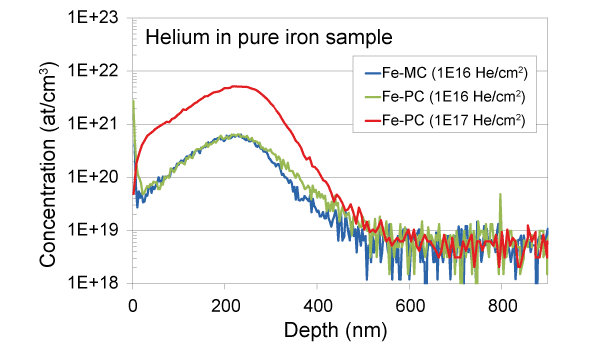
In a recent study, the distribution of helium in implanted single crystal and polycrystalline Fe samples was measured, and concentrations of 5E18 at/cm3 (~60 ppm) and above were detected, confirming the superior depth analysis capability and excellent detection limits provided by the IMS 7f/7f-Auto equipment.
The detection of CsHe+ molecular ions proves to be an effective method to overcome the very high first ionization potential of helium. Concentrations of 60 ppm and above can be measured.
Data from H. Lefaix-Jeuland et al, Nuclear Instru. and Methods in Physics Research B (2013).