

Controlling impurities by SIMS – High-performance trace analysis for light elements
Conventional microanalysis techniques such as Glow Discharge Mass Spectrometry (Glow Discharge Mass Spectrometry - GDMS) cannot measure light elements (H, C, N, and O) due to high background signal (background signal) levels. Time-of-Flight SIMS (Time-of-Flight SIMS / ToF-SIMS) can analyze atmospheric gas elements, but only achieves average detection limits due to the very low data acquisition rate and contamination issues stemming from its inherent pulsed ion beam design.
Based on dynamic SIMS (dynamic SIMS), the IMS 7f-Auto system is designed to achieve excellent detection limits for light element measurements, thanks to:
The design of the magnetic sector mass spectrometer (magnetic sector mass spectrometer) and the continuous ion beam sputtering process (continuous ion beam sputtering) providing extremely high sensitivity;
The ultra-high vacuum analysis chamber (UHV analysis chamber) with optimized vacuum conditions minimizes the background signal generated by residual gases;
The fully automated six-sample storage chamber provides high processing efficiency, as multiple samples can be vacuumed and outgassed (outgassed) overnight;
The high-density primary Cs ion beam allows for high sputtering rates, significantly improving detection limits.
Furthermore, the IMS 7f-Auto also provides the capability for depth profiling (depth profiling) with high depth resolution and high processing performance, while also being able to provide information on uniformity with sub-micron lateral resolution (sub-micron lateral resolution).
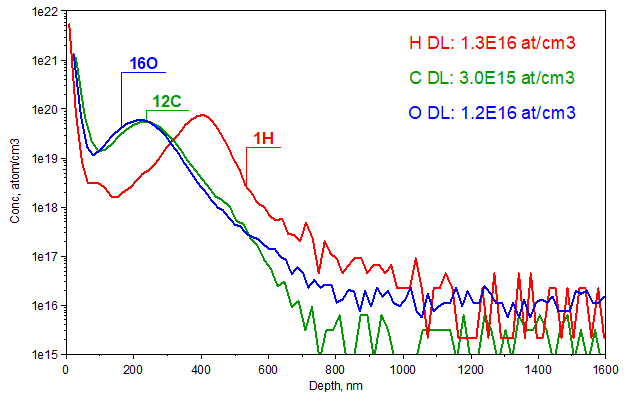
Above: Excellent oxygen detection limit in Si background (low level E16 at/cm3) using a primary ion beam Cs+ with high collision energy of 15keV under varying sputter rate conditions (sputter rate - SR) . Such depth profiles can be recorded up to several microns deep in just a few minutes.