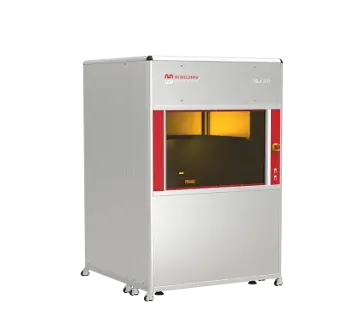

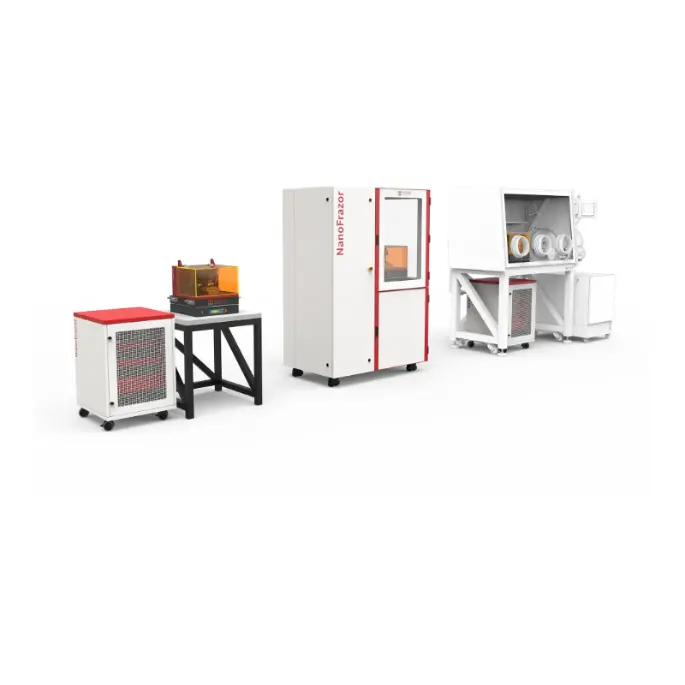



Main features
- Maskless Aligner – projects directly from digital data via SLM, no chrome mask needed, shortens manufacturing cycle
- Raster Scan – direct light modulation, optimizes blank areas, two-dimensional writing process
- High alignment accuracy – global alignment and field-by-field alignment
- Two simultaneous wavelengths – 405 nm (8 W) and 375 nm (2.8 W) lasers can be installed at the same time, compatible with all broadband optical barriers and SU-8
- Draw Mode – directly add details (labels, markers, electrical connections) to camera images, no CAD file needed
- Superior flexibility – substrates from 3×3 mm² to 9″×9″, thickness 0–12 mm, chuck options for thin/curved substrates.
Detailed description
Technology & principles
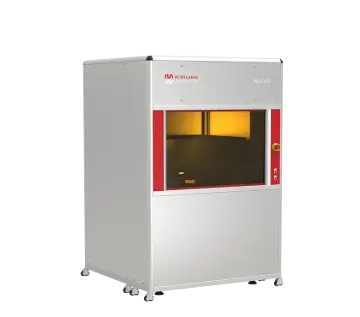
The MLA 150 uses a 2D spatial light modulator (SLM) to project design data directly onto the optical barrier-coated substrate. The Raster Scan writing strategy with an XY table, direct light modulation, optimizes blank areas and two-dimensional writing ensures speed and quality.
Limitations of traditional lithography
- Laboratories need a reliable system that is easy to operate and has low maintenance.
- Alignment between layers for complex structures requires high precision.
- Combining different lithography technologies (e-beam, t-SPL) in the same process faces alignment challenges.
Advantages of the MLA 150 maskless lithography system
- Designed with a long-lasting laser source, low operating costs.
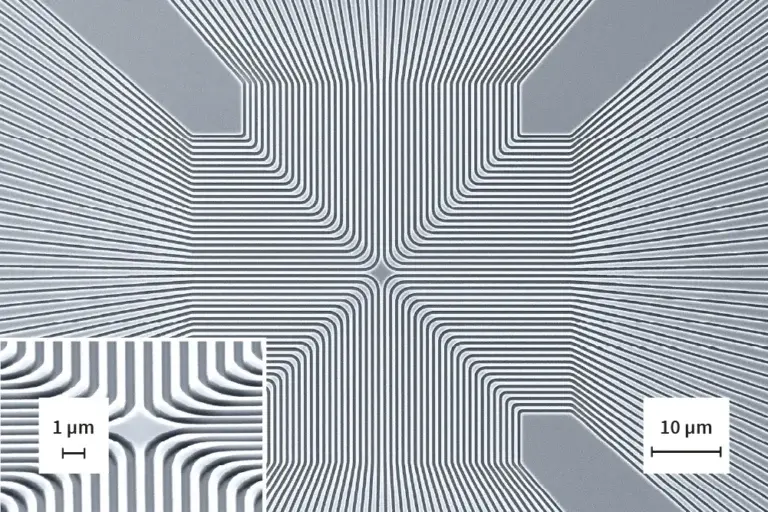
- Precise alignment of 250 nm locally, 500 nm globally, rotation/offset/stretching/cutting compensation, supports mix-and-match with other tools.
- The system allows cross-alignment between e-beam, t-SPL, and laser lithography, easily integrating multiple devices.
Integration & expansion
Integrated software: exposure wizard, optical barrier database, automatic labeling/serial number, tracking substrate history