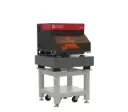


Key features
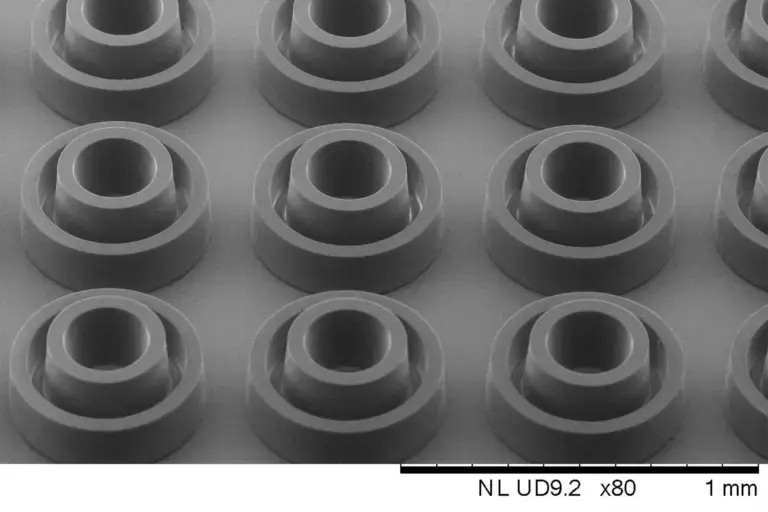
- Standard Raster Scan mode: etching time is independent of structure size or pattern density, superior image quality
- Optional Vector Scan mode: creates curves with minimal edge roughness, maximum linear etching speed of 200 mm/s
- Variable Resolution: select up to 3 levels (Raster) or 5 levels (Vector) directly in the software
- Overall camera with a field of view of 13×10 mm, easily locates alignment marks and details on the substrate
- Wavelength options: 390 nm or 365 nm LED (Raster), 405 nm and/or 375 nm laser (Vector)
- Easy small sample handling, automatic focusing allows precise exposure down to the edge of the sample
- Maximum etching area of 150×150 mm, maximum substrate size 6″×6″, thickness 0.1–12 mm
Detailed description
Technology & principles
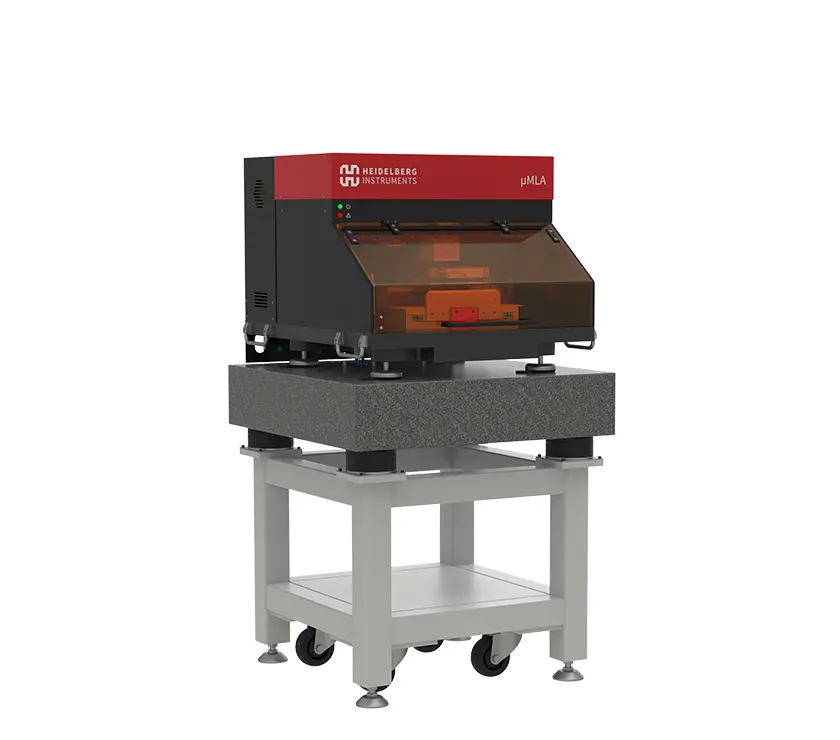
µMLA belongs to the maskless lithography line of desktop machines. The digital design is projected directly onto the photoresist layer through a 2D spatial light modulator (SLM), without the need for a physical mask. The system has two exposure modes: Raster Scan (standard, high speed) and Vector Scan (optional, creating smooth curves).
Limitations of traditional lithography
- Laboratories and R&D facilities need lithography machines but do not have enough space and budget for large systems.
- Curved waveguide processing using traditional raster methods often results in rough edges.
- The equipment is not flexible in terms of wavelength, it is difficult to adapt to various types of photoresists.
Advantages of the µMLA maskless lithography system
- Desktop design – suitable for limited space, easy to integrate.
- Optional Vector Scan Mode – creates curves with low edge roughness.
- Simultaneous support for multiple wavelengths (LED 390/365 nm, laser 405/375 nm) – compatible with various types of photoresists and processes.
Integration & expansion
Built-in overall camera, optical autofocus.