
Key features
- One scanner for everything – The XR scanner achieves an XY scan range of 100 μm and a Z of 12 μm, scanning from atomic level up to microstructure 100 μm without needing to change the probe.
- Superior scanning speed – Many samples can be captured at a line rate of ≥20 Hz (scan size ≤10 μm), with a typical imaging time of <1 minute.
- Proprietary blueDrive™ Tapping Mode – Uses photothermal excitation (640 nm) instead of piezoelectric, increasing stability, reducing probe wear, and providing high repeatability values even after 1000 images.
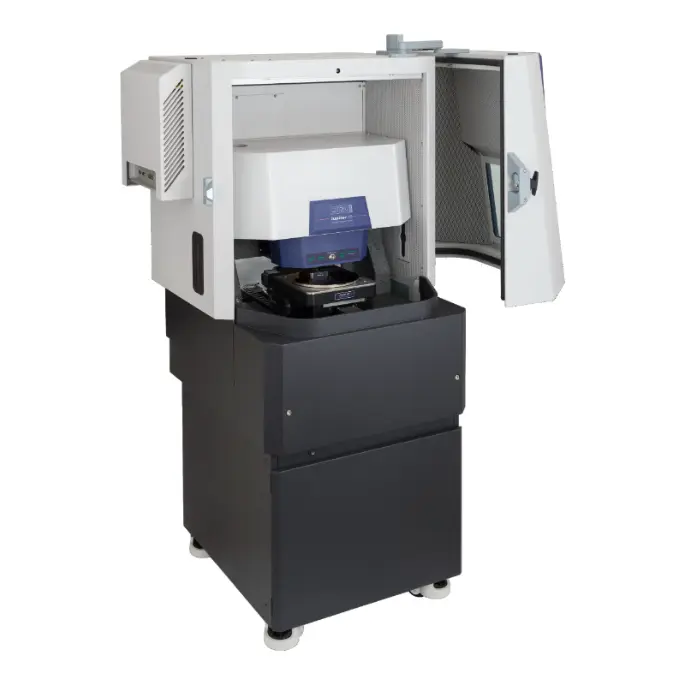
- Automatic, user-friendly setup – Laser and detector alignment with a single click (SpotOn), quick probe change on the detachable Z scanner. A 210 mm sample stage with vacuum and magnets, moving the entire 200 mm wafer in just 5 seconds.
- Multiple AFM modes available – Including Contact, Tapping, Phase, LFM, Force curves, Nanolithography, AM-FM Viscoelastic Mapping, Contact Resonance, Dual AC, Loss Tangent, EFM, KPFM, MFM, DART PFM, Switching Spectroscopy PFM, Vector PFM. CAFM option, Fast Force Mapping.
- Industrial metrology integration – Multi-site measurement automation using MacroBuilder, completing each site in ~1 minute. Linear LVDT sensors, do not require recalibration, reliable for quantitative measurements.
Detailed description
Technology & principles
Jupiter XR uses integrated XR scanner technology with both a wide scan range (100 μm XY, 12 μm Z) and high speed thanks to the flexure mechanism and new generation LVDT sensors (noise X/Y <150 pm, Z <35 pm). blueDrive Tapping Mode uses a 640 nm laser diode to stimulate the photothermal oscillation of the cantilever instead of traditional piezoelectric, helping to stabilize amplitude and phase, reduce noise, and increase repeatability.
Common limitations of AFM
Large sample AFM (200 mm wafer) often trades off resolution / scan range / speed. Manual alignment setup for AFM is time-consuming, requiring experienced technicians. Probe wear affects roughness measurements, metrology. Moving positions on the wafer is slow, lacking accuracy.
Advantages of the Jupiter XR system
- XR scanner scans from 0.1 nm to 100 μm with just one probe; line speed up to 20 Hz → 512 line images in 26 seconds.
- SpotOn: laser/detector alignment with one click. ModeMaster: automatically configures the mode. GetReal: calibrates sensitivity and spring constant without touching the sample.
- blueDrive reduces probe wear → repeatable roughness after 1000 images.
- 210 mm vacuum sample stage, speed 40 mm/s, moves to any point on a 200 mm wafer in 5 seconds, micron accuracy.
Integration & expansion
- Accessories: high-temperature heating, liquid cell (similar to MFP-3D).
- MacroBuilder software: fully automates the measurement and offline analysis process, suitable for production QA/QC.
- Linear LVDT, does not require recalibration.