

What is X-Ray Computed Tomography (CT)?
X-Ray Computed Tomography (CT) is a non-destructive technique used to display the internal features of solid objects and to obtain digital information about their geometry and three-dimensional characteristics.
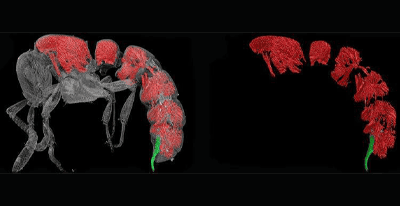
Synchrotron X-Ray Computed Tomography provides a high-quality X-Ray source to capture the three-dimensional internal structure of real objects non-destructively and with high spatial resolution from micrometers to nanometers. This allows for detailed microstructural analysis of various types of materials such as small engineering components.
A CT image is often referred to as a slice, as it corresponds to what the scanned object would look like if it were cut open along a plane. Think of it simply as a slice from a loaf of bread, because just like a slice of bread has thickness, a CT slice corresponds to a certain thickness of the scanned object. Therefore, while a typical digital image consists of pixels, a CT slice image is made up of voxels. Proceeding similarly one step further, just as a loaf of bread can be reconstructed by stacking all its slices, a complete volume of an object is obtained by acquiring a continuous CT slice.
The gray levels in a CT slice image correspond to X-Ray attenuation, reflecting the ratio of X-Rays that are scattered or absorbed as they pass through each voxel. The X-Ray attenuation primarily depends on the characteristics of the X-Ray energy and the density and composition of the material being imaged.
Basic principles of X-Ray Computed Tomography (CT)
The imaging of a cross-section involves projecting X-rays onto an object from multiple angles and measuring the reduction in intensity along a series of straight lines. This reduction is characterized by Charlie's Law, which describes the decrease in intensity as a function of X-ray energy, path length, and the material's linear attenuation coefficient. A specialized algorithm is then used to reconstruct the distribution of X-ray attenuation in the scanned volume.
How does a computed tomography (CT) scanner work?
The elements of X-ray tomography are the X-ray source, a series of detectors measuring the attenuation of X-ray intensity along many ray paths, and the geometry rotating with respect to the object being imaged. Different configurations of these components can be used to create CT scanners optimized for imaging objects of varying sizes and layouts.
Most CT systems use X-ray tubes, although tomography can also be performed using synchrotron radiation sources (Synchrotron X-ray microscopy), or gamma rays as a monochromatic X-ray source. Important tube characteristics depend on the target material and maximum X-ray energy, the X-ray spectrum produced; current, which determines the X-ray intensity; and focal spot size, which affects spatial resolution.
Most X-ray detectors use scintillator photomultiplier tubes. Important parameters include the scintillator material, size and geometry, and what the scintillation detects and counts. Generally, smaller detectors provide better image resolution but reduce the counting rate because their signal collection area is smaller compared to larger detectors. To compensate, longer acquisition times are used to reduce noise. Common scintillation materials include Caesium iodide, gadolinium oxysulfide, and sodium metatungstate.
What are the strengths and limitations of X-Ray Computed Tomography (CT)?
Strengths
- Completely non-destructive 3D imaging
- Little or no sample preparation required
- Reconstruction of 3D structures, allowing extraction of voxel-level structural details.
Limitations
- Resolution limited to about 1000-2000x the diameter of the object slice; high resolution requires small objects
- Limited resolution means the obtained material images are not high.
- Calibration of gray levels to more complex attenuation coefficients by polychromatic X-rays.
- Geological specimens are often large, difficult to penetrate with low-energy X-rays, reducing resolution capability
- Not all features have a sufficiently large contrast reduction for high-quality imaging (carbonate fossil i…).
- Image reconstruction can complicate data collection and interpretation.
- Large data volumes (gigabytes +) may require significant computing power for visualization and analysis
What are the applications of X-Ray Computed Tomography (CT)?
X-Ray Computed Tomography (CT) has many applications in practice, in industry, healthcare, as well as in engineering and life sciences.