

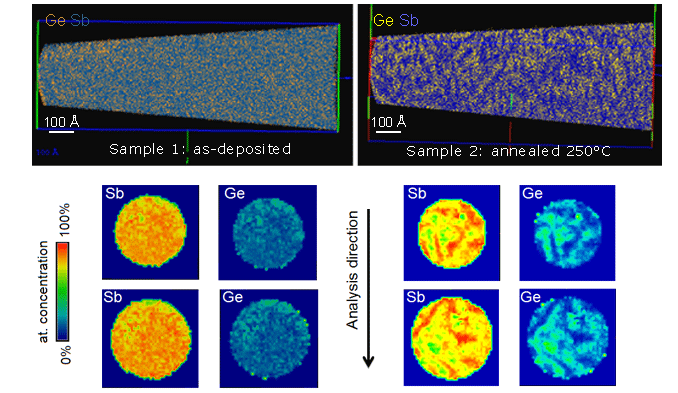
Thanks to its unique spatial resolution analysis capability (lateral resolution and sub-nanometer depth), the CAMECA atom probe performs quantitative analysis at a standard atomic scale in materials.
In this study, the LEAP atom probe was used to investigate the phase separation process in Ge 15 Sb 85 , a material used in optical and electronic data storage devices.
Two analyses were performed: one on the unprocessed sample (left), and one on the thermally annealed sample (right).
While the distribution of Ge and Sb atoms is uniform on the 3D map of the unprocessed sample (top left), Ge-rich regions are clearly visible in the 3D reconstructed image of the thermally annealed sample (top right). Comparing data between the two samples shows that phase separation at the nanoscale occurs during thermal processing.
By extracting a 1nm thick slice in the perpendicular direction and using false color on the quantitative atomic concentration scale from the nano volume, clearer evidence of phase separation can be observed. Note that the size of the phase separation is only a few nm. The technique of imaging slices
using atom probe tomography (Atom Probe Tomography) is the only analytical technique that provides both quantitative composition and 3D elemental mapping at the atomic level of chemical inhomogeneity in materials. Similar to STM, a single atom and its neighboring atoms can be imaged, but the 3D atom probe offers 2 main advantages:
- Elemental analysis, allowing for the determination of the chemical composition of each detected atom.
- Depth resolution, helping the chemical mapping of atoms to truly have three-dimensional properties.
Image provided by M. Salinga and M. Wuttig (Department of Physics, RWTH Aachen University, Germany).