

In plant science, genetically modified cations of crops to improve the absorption of trace elements such as Cu, Fe, and Zn is a major research focus, as it directly impacts the increase of micronutrient content and crop yield. This work is crucial to address issues in areas of the world with poor soil nutrition. To identify the transport mechanisms and pathways leading to the demand for the absorption of trace elements, it is necessary to locate such metals at the cellular level and at different growth stages of the plant. X-ray fluorescence system micro (micro) AttoMap (microXRF) provides sensitivity at the femtogram level and sub-cellular resolution that meets the above requirements.
INTRODUCTION
Understanding the spatial distribution of inorganic components in plant samples is extremely important in agriculture and the environment, including:
- Phytoremediation techniques, in which plants need to remove harmful substances from contaminated land;
- Phytomining, in which plants can absorb and hyper-accumulate valuable minerals that provide economic and environmentally friendly benefits; and • Agricultural research, in which plants' metal absorption is regulated to improve crop growth, reduce the uptake of harmful factors, and increase the micronutrient value of crops.
Understanding the importance of trace metals in plants is significant, but analysis is truly a major challenge. It often requires the use of Synchrotron acceleration systems. Millions of dollars have been invested in particle accelerator facilities to create high-resolution X-ray beams and the necessary analytical sensitivity.
However, the synchrotron beam is used excessively, and overall operation has many factors that are not suitable when using these facilities such as: funding, travel conditions, infrastructure…. The facilities for particle acceleration are only available in a few developed countries in the world.
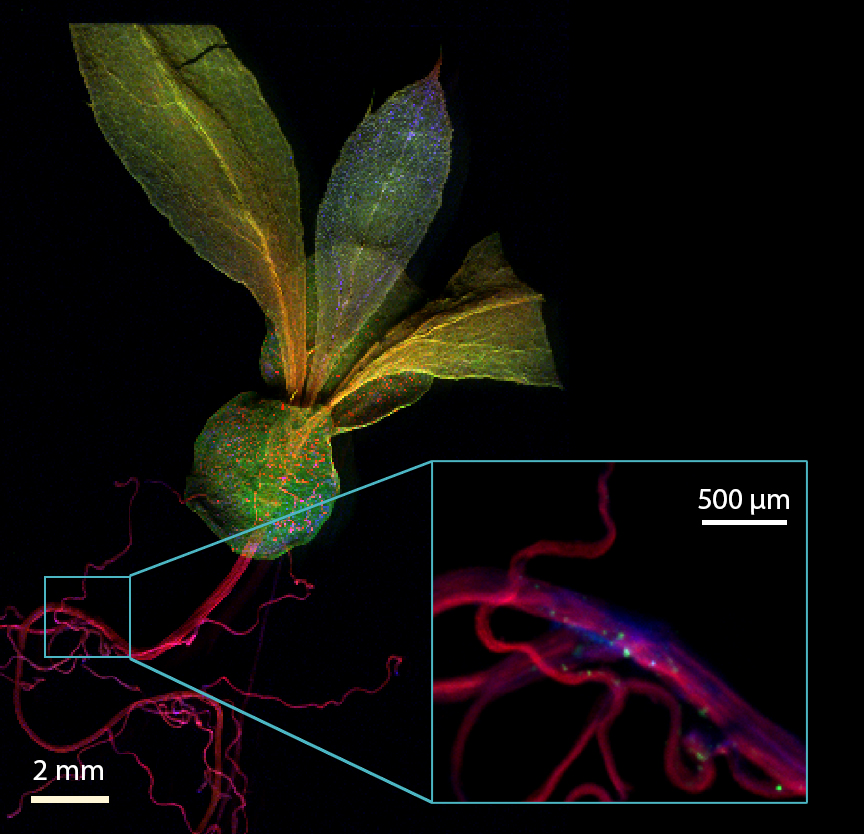
Figure 1 - Spectral map image by AttoMap Micro-XRF on the elemental accumulation of hyperaccumulating plant; including K (red), Ni (blue), and Cl (green). Magnified roots show the micronutrient absorption of Mn (green). The research of Dr. van der Ent and Dr. Peter Erskine, University of Queensland, Australia
The Sigray AttoMap was created as a miniaturized synchrotron laboratory, a new microXRF developed for agricultural research that has been used in the study of iron (Fe) absorption and distribution. This is one of the most challenging applications for microXRF due to the extremely low Fe content (10-12 picograms - scale), requiring device sensitivity to reach parts per million (ppm) for measurement. Iron is very important for plant development and plays a key role in respiratory and photosynthetic reactions;
About 30% of the world's arable land is considered to have low iron content for plant development. The research results indicate that the transport protein, OPT3 (Oligopeptide Transporter 3), is an intermediary for loading Fe into leaf development, indicating that OPT3 regulates Fe demand from shoots to roots.
METHOD
This study analyzed genetically modified arabidopsis leaves (OPT3-3), with the permission of Professor Olena Vatamaniuk (Associate Professor of Soil and Crop Sciences, Cornell University), and a control sample (wild type) to determine the potential role of the OPT3 protein. Leaves from the plant were sampled at various growth stages: one leaf was taken from the same plant at 16 days of growth and another leaf at 19 days of development. All factors were analyzed simultaneously on Attomap microXRF, to describe the distribution of essential minerals related to plant growth, namely Ca, Zn, Mg, Fe, and K.
For the 16-day leaf, an area of 3.5 mm x 3.8 mm was recorded in mapping scan mode at a spot size of 10 μm and a step size of 10 μm. The X-ray source was configured using a tungsten (W) filament, at an emission voltage of 35 kV. Note that although the tungsten (W) target was chosen for its compatibility across a wide range of elements, the copper (Cu) target is optimal for Fe (6.4 keV). Subsequent studies found that even better sensitivity for Fe could be uniquely achieved in AttoMap by using a patented multi-target X-ray source.
With the 19-day leaf being 4.0 mm x 8.3 mm with a spot size of 10 μm and a step size of 15 μm. The X-ray source settings were kept the same as for the 16-day leaf.
RESULTS
The results indicate abnormalities at the picogram level in the distribution of Fe with the opt3-3 plants. The Fe content in both 16-day and 19-day leaves was primarily found in the small veins of the leaves, located near the hydathodes and towards the peripheral leaf blade, with increased Fe accumulation in the small central veins of older leaves. Because the increase in Fe was found in locations where OPT3 shows preference, it suggests that OPT3 may be very important for loading Fe back into the phloem, the capillary pathways, and nutrients from the leaves down to the stem to support plant growth. In comparison with natural leaves, it shows significantly lower Fe distribution in the leaves, with small accumulations only seen at one outer edge.
Professor Olena Vatamaniuk's studies on other factors related to the transport of water and soluble substances from the leaves, such as potassium and calcium, did not show significant differences between natural leaves and opt3-3.
This indicates that the transport of other nutrients does not seem to be affected by OPT3. This further confirms the influence of OPT3 on the transport pathway of Fe.
This study demonstrates that with recent developments in microXRF technology in the laboratory, trace elements related to plants (parts per million levels) can now be analyzed with synchrotron technology. In this study, AttoMap provides picogram-level measurements at sub-cellular resolution (<10 μm). Interestingly, the AttoMap laboratory system appears to have higher sensitivity for elements such as Ca (3.7 keV) and K (3.3 keV) compared to previous synchrotron results. This may be due to AttoMap's polychromatic beam, which provides improved sectioning compared to the monochromatic 11 keV synchrotron beam used, and previous studies have suggested that the “white light” beam is much preferred over the standard synchrotron configuration for environmental samples [3]. The quantification cation of the signal increase for lower atomic number elements achieved using AttoMap has been utilized for subsequent studies. AttoMap provides not only distribution images of the elements but can also be used for relative quantification of each element. Exciting future possibilities for this system include in-vivo studies, where elements involved in the growth and life of plants or roots can be monitored. This is facilitated by the large working distance (convergence distance from the source to the sample), for example, with root samples in soil / or leaves with non-flat surfaces.