
Main features
- Ultrafast Measurement Speed: Capable of generating and acquiring time-deterministic real-time data at speeds of up to 20,000 points/second across 24 parallel channels, up to 1000x faster than conventional measurement systems.
- Patented hrDAC™ Technology: Upgrading top-of-the-line 20-bit DA converters to true 22-bit resolution devices, allowing for ultra-small voltage steps (4.8uV) in a +/-10V output range without the need for mixing circuits or external attenuators.
- Fully Integrated Digital Architecture: Converting all analog signals to the digital domain right from the initial stage, completely eliminating crosstalk and noise from the external environment.
- Intelligent Adaptive Oversampling (Intelligent Adaptive Oversampling): Automatically optimizing the SNR ratio in real-time based on the quality of the input signal, helping to accelerate in noisy background areas and collect high-resolution data in sample interaction regions.
- Extreme Dynamic Range Lock-In (Extreme Dynamic Range Lock-In Amplifier): Supporting up to 8 independent phase-locked loops with superior linear range over 120dB and dynamic reserve over 100dB, accurately measuring small signals down to 10uV in a background range of +/-10V without the need for gain switching.
Detailed description
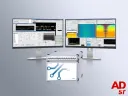
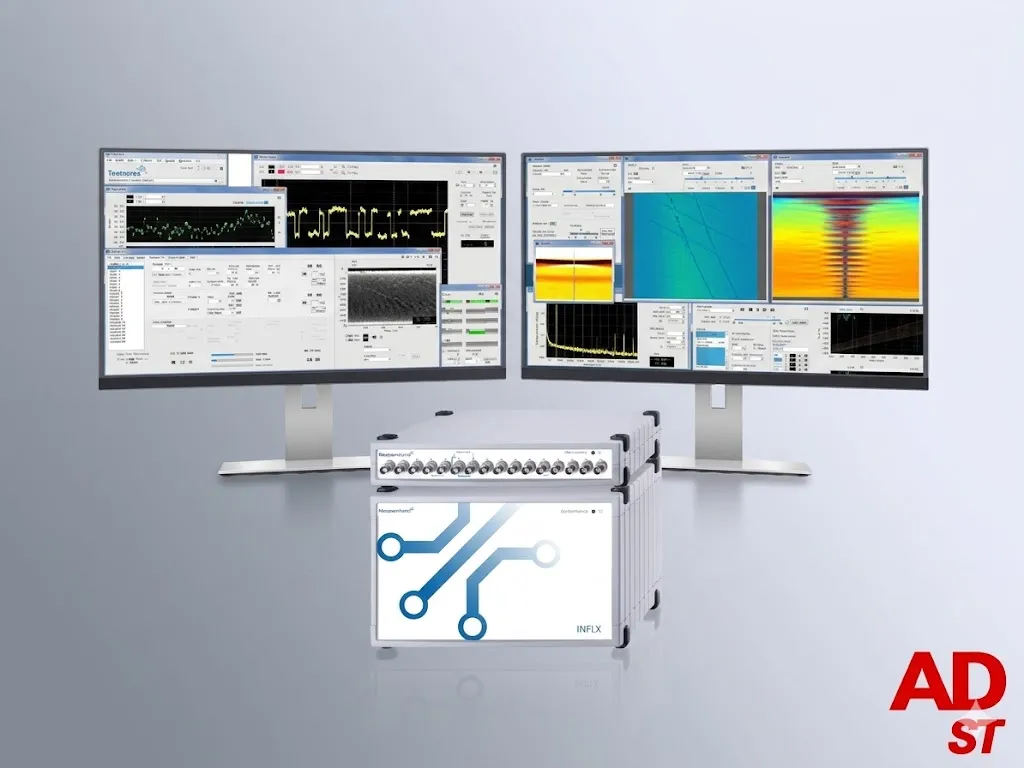
Technology/Principle: Nanonis Tramea™ completely replaces the bulky 19" rack structure containing multiple single-function devices (such as DC power supplies, multimeters, lock-in amplifiers, oscilloscopes) with a TSC (Tramea Signal Conversion) module directly connected to the real-time controller TRC. The system uses 18-bit AD converters operating at a speed of 1 MSPS (analog bandwidth 100kHz) to digitize the input signal. Thanks to the high-end NI Pxi-7965R FPGA processor, all DC, AC multi-frequency measurements or real-time analysis can occur simultaneously on the same single differential BNC input without the need to change the mechanical wiring scheme.
Highlights: In traditional quantum transport measurements (such as measuring the differential conductance of a quantum point contact - QPC), scanning a data matrix of 500,000 points typically takes over 11 hours, easily leading to errors due to temperature drift and generating artifacts due to uneven point spacing. Nanonis Tramea completely addresses this issue by reducing the analog scanning time to just 36 minutes at high resolution (20x faster) or just under 2 minutes at maximum speed (360x faster) with sharp image quality and significantly less noise. Signal stability is ensured by a dedicated thermally stable voltage reference, reducing the temperature drift coefficient to below 3umV/^\circC and output drift to below 1.5uV within 12 hours.
Integration/Expansion: The Nanonis software framework inherits over 10 years of development from the world-leading scanning probe microscopy (SPM) control system. Customers using the Nanonis BP5 system can easily upgrade to the Tramea configuration to expand quantum transport measurement capabilities on existing hardware. In terms of hardware, users can scale the system from 8 standard input/output channels to 16 or 24 channels by adding additional TSC auxiliary boxes to the central TRC unit. Additionally, the open-source TCP programming interface allows for flexible integration and control of the system through environments such as Python, Matlab, C++, or specialized LabVIEW libraries.