
Key features
- High brightness X-ray source enables high throughput in the lab and full elemental range acquisition.
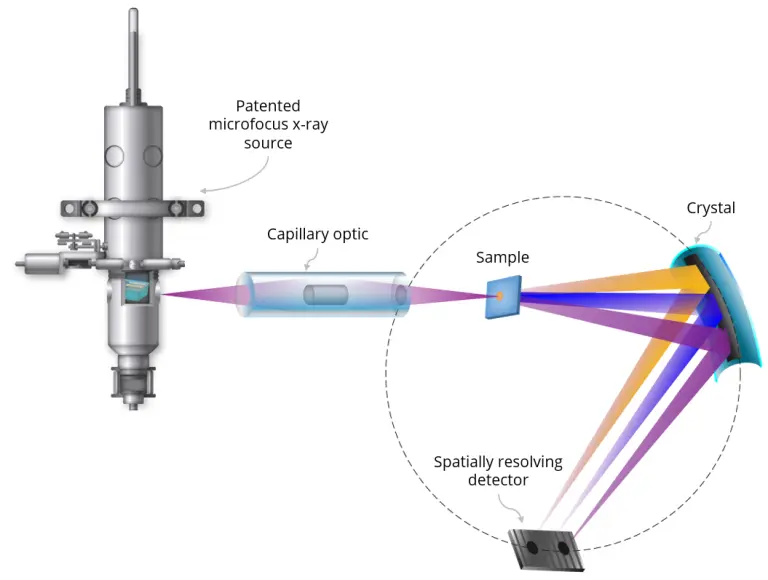
- Capillary X-ray optical system to create a small focal spot (100 µm diameter) at the sample
- Vacuum chamber achieves pressures down to <10^-5 Torr to collect chemical information about low atomic number elements.
- From 1.7 keV to 10 keV, allowing analysis of low atomic number elements.
- Software visual for data collection and analysis. Data can be exported to CSV files for software like Athena and Artemis to read.
Detailed description
Technology & Principles:
QuantumLeap - V210 & H2000 brings the long-awaited power of X-ray absorption spectroscopy (XAS). XAS is a technique in which X-ray energy is scanned in incremental steps near the specific absorption threshold (binding energy) of an element to be studied. At this energy level, X-rays are typically absorbed by an electron, which is then emitted from the atom. A Synchrotron technique to determine the electronic structure of elements, for individual laboratories.
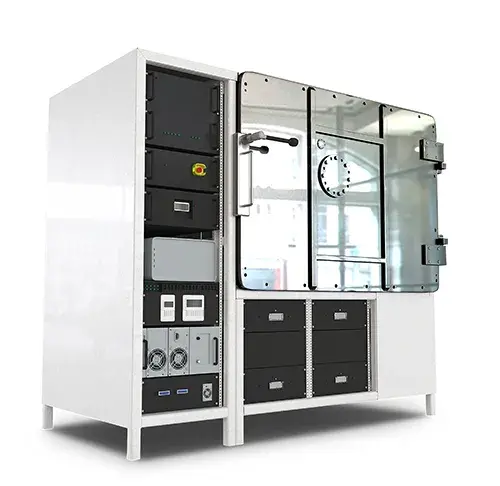
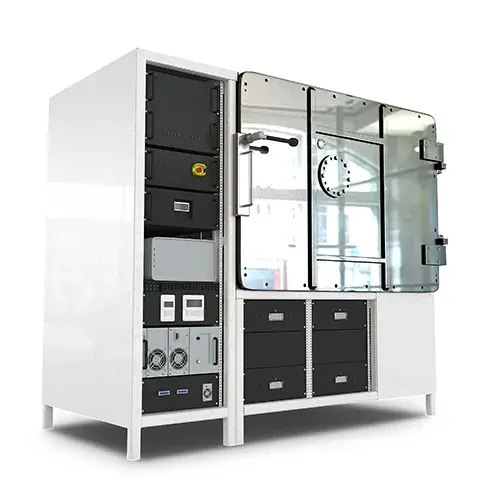
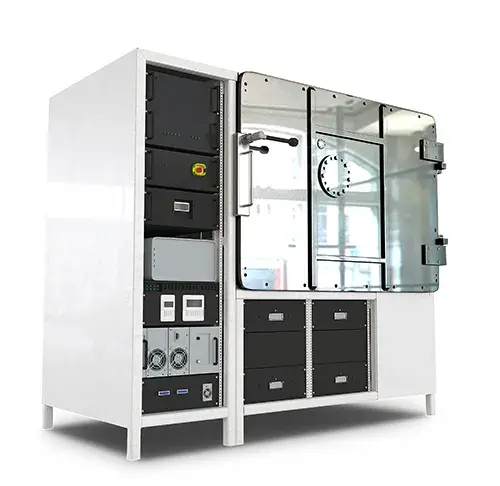
QuantumLeap - V210 microspot transmission mode and vacuum chamber structure:
Completely overcomes the difficulties of studies concerning elements with low atomic numbers (low Z) thanks to the design of a system fully contained within a vacuum enclosure, providing a microspot beam with a focal size reduced to 100x100 µm in transmission-mode.
QuantumLeap - H2000 hybrid XAS system:
Provides both transmission-mode and fluorescence-mode XAS. This system is an ambient system, with line focus spots reaching 50 µm in the short dimension and 1-2 mm in the long dimension.
Mapping setup and overnight automation:
Both systems are capable of mapping chemical states across the entire sample surface according to the corresponding spot size while allowing for automated data acquisition based on a pre-set overnight procedure for multiple samples and/or different points. Addresses resource and time costs when having to set measurement parameters manually for each location.
Integration/ Expansion:
Featuring an intuitive graphical user interface (GUI) for data collection including the ability to set up formula-based scanning processes to map individual points or for multiple samples (sample holders available for up to 16 samples with a diameter of 3 inches).
Data can be exported to CSV files for analysis software including Athena and Artemis.